The Most Profitable Black Friday Is Usually a Narrow One
 Ashton Lee Hudson8 min read
The majority of brands decide what their Black Friday offering will be by looking in two directions: at what competitors are doing, and at what the event did last year. If others are discounting by a certain percentage, or last year’s headline numbers were big, the event goes ahead in much the same shape.
The final call is often made in a marketing meeting just a few weeks out. And more often than not, that discussion asks not whether discounting pays at all, but how deep the discount should be.
Black Friday’s date moves each year, but the decision behind it rarely gets more than a few weeks’ thought. That’s enough to make it properly, though not enough to make it twice. Making it properly starts with questioning both of those reference points.
Check the Market Is Winning Before You Follow It
On the face of it, following the competitors you align with on positioning and price is the sensible move. It ensures you’re not left behind in your category, and it demands little imagination a few weeks out. But first, it’s worth asking whether those competitors are actually doing well out of Black Friday.
Recent evidence suggests not. In 2025, IMRG found that online revenue across Black Friday week fell 1.2% year on year. That’s despite 60% of retailers launching their campaigns earlier than in 2024, and almost five times as many as in 2021 having one live on the first working day of November.
Discounts got deeper too. RevLifter’s VP of Marketing, Dan Bond, reported that the share of items marked down by 15% or more rose from 45% to 50%, yet most categories still declined. Faced with weakening consumer confidence and squeezed spending ahead of that year’s Budget, brands responded in the way far too many do: by discounting harder.
Shoppers, meanwhile, were cooling on the event. PwC forecast £6.4bn of UK Black Friday spending, only marginally up on 2024, while the share of consumers interested in the event fell from 53% to 46%. Nor did shoppers expect the following year to be different. A survey for Omnisend in August 2026 found planned spending across Black Friday and Cyber Monday roughly a third lower than the year before.
None of this means Black Friday can’t work, whatever the size of the brand. It means that copying the market is copying a pattern of deeper discounts for flatlining revenue.
Judge Black Friday on What It Added, Not What It Bagged
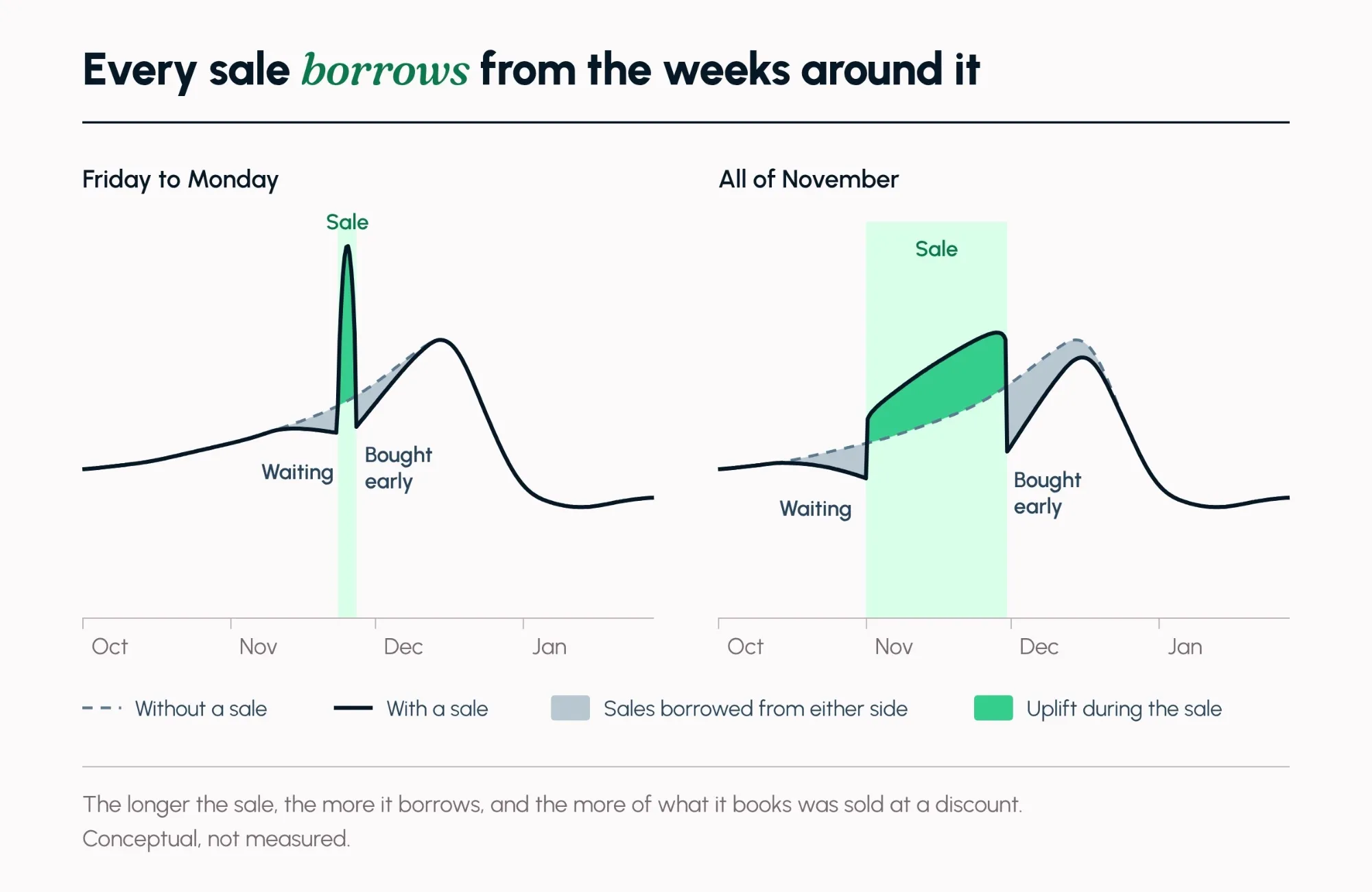
Last year’s results are the other reference point, and they need reading with the same scepticism. Headline revenue over a tight period flatters the event, because much of it would have arrived anyway. Some is pulled forward from October, when customers anticipating an offer simply wait. Some is pulled back from December, from customers who would have paid full price a few weeks later. Like most seasonal sales, Black Friday takes credit for both.
There is a behavioural cost too, and it’s the one most often overlooked. Brands that discount around the same time each year, particularly sitewide, teach their best customers when not to buy. Worse, they build a form of expectation debt: a promise, in this case about price, that must be honoured in future years or risk disappointing. That is particularly true of customers who were acquired through a discount in the first place.
So don’t simply ask what Black Friday booked. Ask what it added: the contribution from orders that would not otherwise have happened, less the margin given away on orders that would.
Put a Number on the Uplift Before You Settle on the Discount
It always surprises me how few brands work out the uplift a discount needs before settling on one. It’s not that they don’t know volume is what a discount needs to pay for itself. It’s that putting a figure on that volume often reveals the plan is unviable, and sends everyone back to the drawing board.
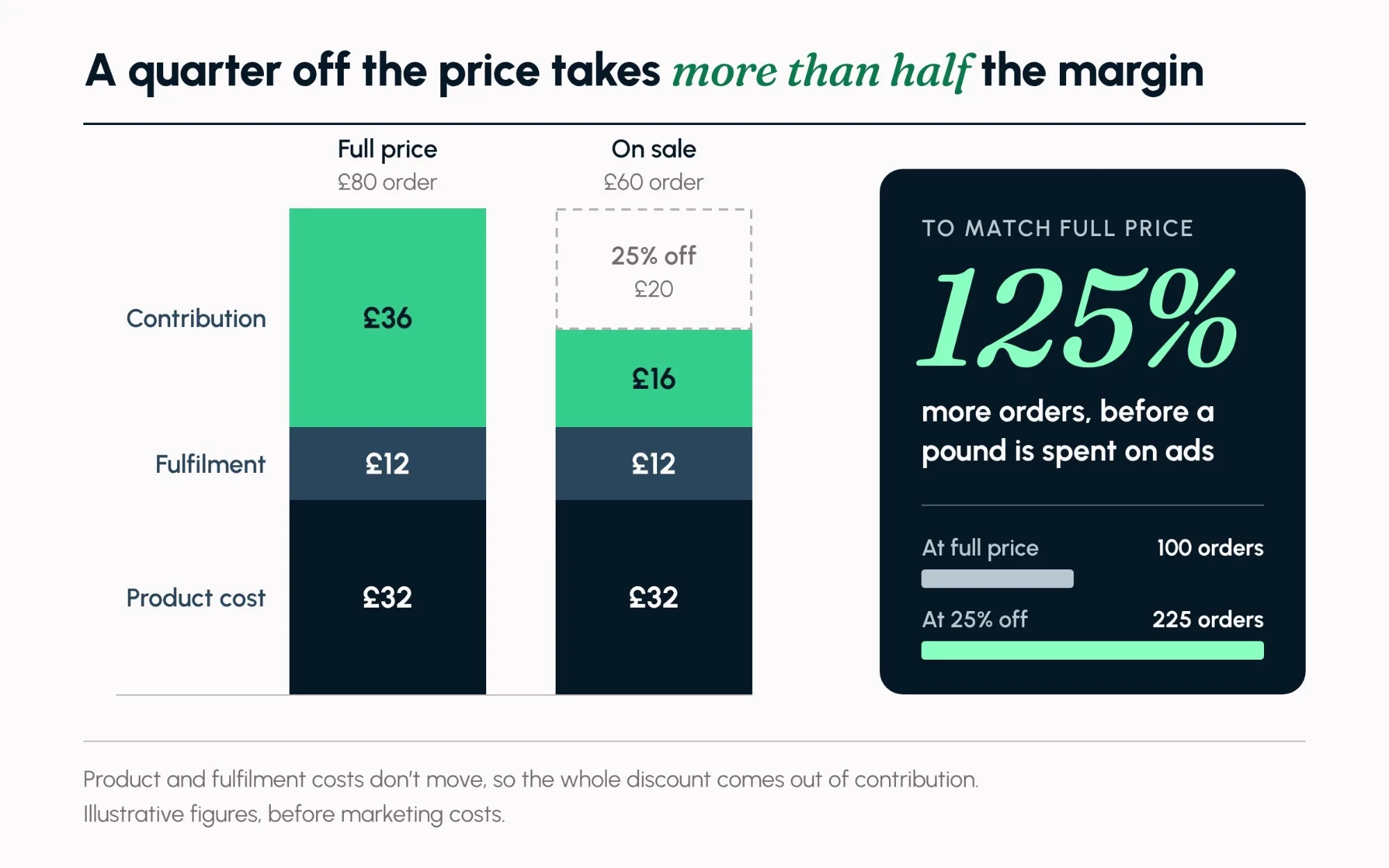
Let’s look at a simple example. A brand’s average order was around £80, and it planned a 25% discount that would bring that down to around £60. Its products cost around £32 per order, with fulfilment a further £12. So a typical order contributed £36 at full price, but only £16 during the sale.
To earn the same contribution, the brand would need 125% more orders: 225 discounted orders for every 100 it would have taken at full price. On hearing that, the marketing team would like look increasingly nervous. This is as the conversation would move from “of course a 25% discount will deliver more volume” to “but will it deliver at least 125% more?”
And that example overlooks the cost of marketing. Discounts usually lift conversion rate, which should bring acquisition costs down, but Black Friday also drives advertising costs up. In my experience, the benefit of a higher conversion rate is often muted by the cost of competing for ad space.
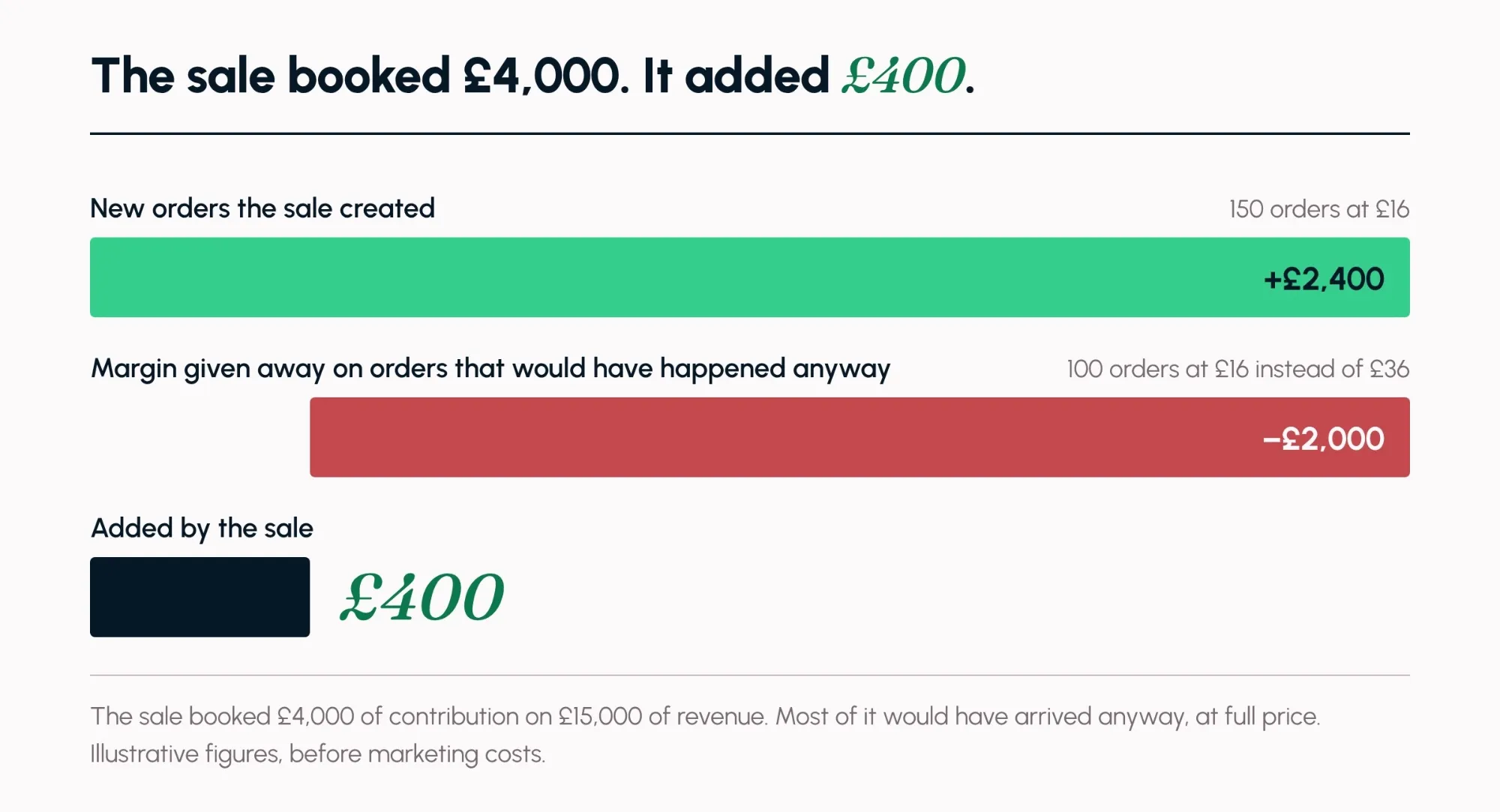
Pull-forward makes it starker still. Suppose the sale delivered 250 orders, but 100 came from customers who would have bought at full price within a month or so anyway. Revenue of £15,000 and contribution of £4,000 sounds healthy. But those 100 customers would have contributed £3,600 regardless, so the sale’s incremental contribution was just £400.
If your own numbers tell a similar story, the answer isn’t necessarily to cancel the campaign. It’s to change who receives the discount, and what form it takes.
One Offer Doesn’t Suit Every Black Friday Shopper
Start with who. Black Friday traffic is typically made up of three distinct segments, and each justifies different treatment.
- New customers. A discount to win the first order is often a justifiable acquisition cost, but only if you know what that customer is worth over the next year, what they would normally cost to acquire, and whether customers won through a discount go on to expect one.
- Lapsed customers. A discount is often a fair price for reactivation, particularly for those who haven’t bought in over a year. But know your typical gap between orders first, so you’re not discounting customers who haven’t actually lapsed.
- Full-price loyalists. The customers most likely to buy anyway, and so the most expensive to discount. They are also the customers you least want to retrain to wait for one.
A sitewide discount, by design, gives the same margin to all three. In a brand with a strong repeat base, the third group is usually where most of it goes, and the cost doesn’t show during the campaign. It shows over the following year or two.
That isn’t conjecture. In three randomised field experiments, Anderson and Simester found that deeper discounts won a retailer more future business from new customers but cost it around a fifth of future revenue from established ones. A sitewide sale buys acquisition with the loyalty of the customers you already have.
The Mechanic Matters More Than the Percentage
Then decide how. Sitewide discounts are often the product of following the pack, oversimplifying the customer base, or simply a lack of time. But there are several alternatives, and the one you choose decides how much margin the event costs.
- Bundles. These raise order value while giving you control over which products move, typically pairing slower lines that are taking up space with best-sellers that catch the shopper’s eye.
- Gifts with purchase. These offer value without devaluing either the gift or the rest of the range. Paired with a minimum spend, they lift order value while giving away less margin.
- Spend thresholds. Discounts linked to spend, such as £15 off orders over £100, concentrate the saving on larger baskets, spreading fulfilment and advertising costs across more value.
- Tighter windows. These limit how long full-price demand is diverted. A sale that runs from Friday to Monday does far less damage than one that runs throughout November.
These aren’t folklore we consultants lean on when short of ideas. In a 16-week field test reported in the Journal of Marketing, a bonus pack offering 50% more product outsold a 35% discount by around 73%, despite the discount being worth more. Shoppers judged added value more generously than an equivalent cut in price, which is precisely what a well-chosen gift with purchase relies on.
Spend thresholds are well studied too. Research on free delivery thresholds found them very effective at lifting both order rates and basket size, though for the retailer studied, the lost delivery revenue outweighed the gain. And research on an online grocer found that raising its threshold from $80 to $100 cut customer spending by 19%. Thresholds work when they are costed properly and set just above what customers already spend.
The evidence for bundles and tighter windows is thinner. But IMRG’s review of 2025 found that the retailers who did best focused on raising the value of each order through bundles and thresholds, rather than cutting prices further. And the case for tighter windows rests on the pull-forward arithmetic above: the shorter the sale, the less full-price demand it can divert.
Make It a Margin Decision, Not a Marketing One
For most ecommerce brands, the most profitable Black Friday is neither full participation nor sitting it out. It’s a narrow offer: aimed at the customers a discount genuinely moves, built on a mechanic that protects margin, and run for days rather than weeks.
Getting there means changing the question asked in that marketing meeting. Not how deep the discount should be, but what the event will add once pull-forward and the discount itself are paid for. It also means taking the decision out of marketing alone, because most of the cost lands elsewhere. Discount a line that would have sold out at full price in December, and procurement has given away margin for nothing. Customer service absorbs the surge in orders, then a second wave of delivery queries. And finance inherits the cash timing: stock paid for weeks earlier, returns arriving in December, and a January thinned by the sales pulled forward.
However far out you are, that comes down to five decisions:
- Set the baseline. Estimate what the same weeks would deliver without an offer, and judge the event against that.
- Decide who the offer is for. Name the customers it’s meant to move, and limit what everyone else receives.
- Choose the mechanic, then the depth. Work out contribution per order before anything is announced.
- Fix the window. Choose the dates and hold to them.
- Agree how it will be judged. On contribution across October to January, not on the weekend’s revenue.
A Black Friday decided in a rush each November is rarely the only decision being made that way. Our 90-day Diagnostic looks across the whole business to find where profitable growth is being held back, and a discovery call is the place to start.